

Kegels are often not working because of technique, time or the type of leakage. Many people squeeze the wrong muscles, stop before the 4 to 6 weeks MedlinePlus says it can take to notice a change, or are dealing mainly with urgency leakage, which guidelines treat first with bladder training. If practice alone has not helped, supervised training, biofeedback or pelvic floor chair therapy are worth considering.
How Your Bladder, Nerves and Pelvic Floor Work Together
Your bladder stores urine. Underneath it, a group of muscles called the pelvic floor stretches across the base of the pelvis like a hammock. These muscles support the bladder and help keep the urethra, the tube urine leaves through, closed until you decide to go.
Nerves carry signals between the bladder, the spinal cord and the brain. As the bladder fills, messages travel up; the brain decides whether now is a good time; and signals travel back down telling the pelvic floor to hold or to relax.
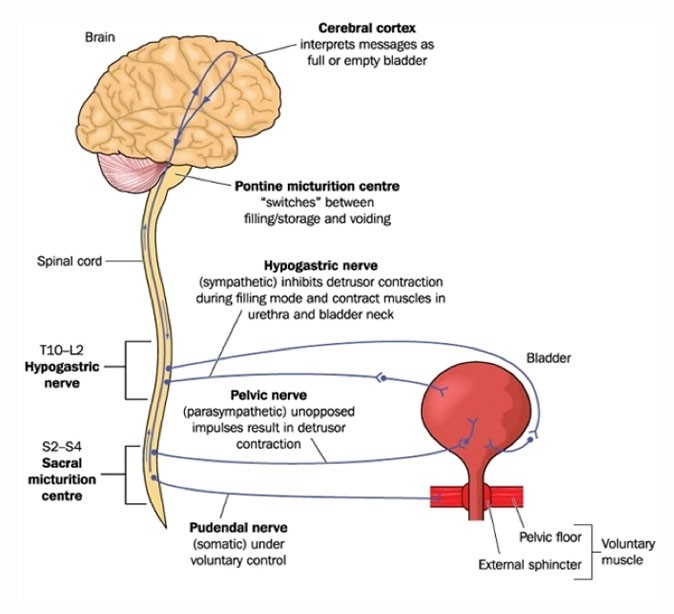
Leaks happen when part of this system is not doing its job. With stress leakage, a cough, sneeze, laugh or jump puts pressure on the bladder, and the support underneath is not strong enough to hold. Pregnancy, vaginal birth and lower estrogen around menopause can weaken that support, and in men stress leakage often follows prostate surgery. With urgency leakage, the urge comes on so strongly that urine escapes before you reach the toilet.
A Kegel is a deliberate squeeze of the pelvic floor to build up that support. The catch: you cannot see these muscles, so it is easy to squeeze the wrong thing without knowing it.
How to Do a Kegel Correctly
MedlinePlus describes the basic method:
- Find the muscles. They are the ones you would use to stop urine midstream or hold in gas. Stopping your urine is only a way to find them: do not practice Kegels while you urinate.
- Squeeze and hold for 3 to 5 seconds.
- Relax for 3 to 5 seconds.
- Repeat 10 times, 3 times a day.
- Keep everything else loose. Your belly, thighs and buttocks should stay relaxed, and you should keep breathing normally.
Why Your Kegels Are Not Working
The most common problem is technique. In a 1991 study, 47 women were given brief verbal instructions on how to do a Kegel. Only 49% then did an ideal Kegel, and 25% used a technique that could promote incontinence. For about half of them, a quick explanation was not enough.
Signs you may be doing them wrong
- Your belly, thighs or buttocks clench when you squeeze.
- You hold your breath during each squeeze.
- You feel yourself pushing or bearing down instead of squeezing.
- You cannot feel anything happen when you try.
- Months of regular practice have brought no change at all.
The leak may not be the kind Kegels target
Supervised pelvic floor training is the first-line treatment for stress leakage, the kind that happens when you laugh, cough, sneeze or exercise. If your main problem is a sudden, strong urge you cannot hold, that is urgency leakage, often called overactive bladder. For urgency, NICE recommends bladder training for at least 6 weeks first, adding medicine if needed. A mix of both is common too. If you are not sure which you have, stress incontinence explained walks through the differences.
How Long Should Kegels Take to Work?
MedlinePlus says you may notice fewer symptoms after 4 to 6 weeks of regular practice, though it can take a few months. For stress leakage, NICE recommends supervised training of at least 8 contractions, 3 times a day, for at least 3 months. After 3 months of correct, consistent practice with no change, it is reasonable to look at the next steps below.
When to see a doctor
Some symptoms need a medical check first. See a doctor if you notice blood in your urine, pain or burning when you urinate, a fever, sudden new symptoms, trouble emptying your bladder, or leakage that started after you began a new medicine.
What to Try Next When Kegels Are Not Enough
The next options either coach your technique or take the guesswork out of it. For the full range, from lifestyle changes to surgery, see the guide to bladder leakage treatment options.
| Option | What happens | Need to find the muscle yourself? | Where it stands in guidelines |
|---|---|---|---|
| Supervised pelvic floor muscle training | A trained clinician checks your technique and sets a program | Yes, with coaching | First-line for stress leakage (NICE), for at least 3 months |
| Biofeedback | You get feedback showing whether you are contracting the right muscles | Yes, with feedback | NICE: consider for women who cannot actively contract the pelvic floor |
| Electrical stimulation | Mild electrical pulses make the muscles contract | No | NICE: consider for women who cannot actively contract; not routinely for overactive bladder |
| Magnetic chair therapy | You sit fully clothed while a magnetic field causes involuntary contractions | No | Not in NIH or NICE treatment ladders; evidence limited and low certainty |
Supervised training with a pelvic floor physical therapist
A pelvic floor physical therapist can check whether you are squeezing the right muscles, correct what is off and build a program you can follow at home. If you cannot feel the muscle contract at all, NICE suggests considering biofeedback or electrical stimulation for women who cannot actively contract the pelvic floor, and a therapist can tell you whether either suits you. Physical therapy is often covered by insurance with a referral. To weigh it against chair therapy, see pelvic floor chair therapy vs pelvic floor physical therapy.
Pelvic floor chair therapy
You sit fully clothed on a chair whose seat produces an electromagnetic field that reaches up to 4 inches deep and causes involuntary pelvic floor muscle contractions: more than 5,600 in a 20 minute session, according to the manufacturer. Because the contractions are involuntary, they do not depend on you locating the muscle or getting the technique right. There are no probes or electrodes, nothing is inserted, and most people read or use their phone. A typical program is 24 sessions over 8 weeks.
The evidence is limited. A 2021 meta-analysis of six small sham-controlled trials found magnetic stimulation reduced stress leakage in women compared with a placebo treatment, although the authors flagged study-quality problems. A 2025 systematic review of five small studies (about 219 women) found chair-based magnetic stimulation was associated with less leakage, but rated that evidence low certainty. None of these studies used the Pelvic Wave chair; they tested other magnetic chairs. Magnetic chairs are not part of the NIH or NICE treatment ladders, and some insurers, including Aetna, classify magnetic pelvic floor stimulation as experimental.
According to the manufacturer, the chair relies on technology that is FDA-cleared for the treatment of urinary incontinence in women. That clearance does not cover men, who talk through suitability at the free consultation. Chair therapy is not suitable for anyone who is pregnant or may be pregnant, has an implanted pacemaker or defibrillator, or has a history of cardiac arrhythmia or atrial fibrillation. Anyone with metal or electronic implants should raise them at the consultation.
Pelvic floor chair therapy at Elume is provided by Restore Innovations, an independent practice located within Elume Medspa. It may help people for whom exercises have not helped enough or are hard to do correctly, and it is meant to sit alongside medical care, not replace it. Learn more about pelvic floor therapy in Fairfax, VA.
Frequently Asked Questions
How do I know if I am doing Kegels correctly?
A correct Kegel squeezes the muscles you would use to stop urine midstream or hold in gas, while your belly, thighs and buttocks stay relaxed and you keep breathing. If other muscles clench or you feel yourself pushing down, the technique needs work. A pelvic floor physical therapist can check it for you.
How long does it take for Kegels to work?
MedlinePlus says you may notice fewer symptoms after 4 to 6 weeks of regular practice, though it can take a few months. NICE recommends at least 3 months of supervised training for stress leakage. If there is no change after that, talk to a clinician about next steps.
Does pelvic floor therapy involve an internal exam?
Pelvic floor physical therapy may include an internal exam, but only with your consent. Pelvic floor chair therapy never does: you sit fully clothed, nothing is inserted and nothing touches the skin. If worry about an exam has kept you from getting help, it is worth knowing both options exist.
Talk It Through With Restore Innovations
If Kegels have not been enough, Restore Innovations can talk through whether pelvic floor chair therapy is worth considering. You can book a free 15 minute phone consultation, where Restore Innovations calls you, or choose a free 30 minute consultation in person at the suite inside Elume Medspa, 3925 Blenheim Blvd, Suite 53-D, Fairfax. You can also call Restore Innovations at (571) 299-8780. Consultations are by appointment only, and the full cost of any recommended plan is explained before the first session.
Sources
- Kegel exercises: self-care, MedlinePlus (accessed 2026)
- Assessment of Kegel pelvic muscle exercise performance after brief verbal instruction, American Journal of Obstetrics and Gynecology (1991)
- Urinary incontinence and pelvic organ prolapse in women: management (NG123), NICE (2019)
- Efficacy of magnetic stimulation for female stress urinary incontinence: a meta-analysis, Therapeutic Advances in Urology (2021)
- Systematic review of chair-based magnetic pelvic floor stimulation in women with urinary incontinence (Sacarin et al.), Journal of Clinical Medicine (2025)
- Clinical Policy Bulletin 0223, Aetna (accessed 2026)